
Every organization, like every human being, grows in stages. Like many schools, we’ve faced moments where our ideals outpaced our structures. At times, we’ve struggled with clarity in process, communication, and role, and in the systems that hold our work together. But these experiences have been our teachers. They have shown us what it truly means to be a learning community: one that reflects, adapts, and evolves.
There are moments of expansion and moments of contraction. Times when things flow easily, and times when we meet growing pains that ask us to pause and reorient. Our school is no exception.
As a Waldorf school, we have long worked through a unique, collaborative model rather than a top-down hierarchy. Our Faculty, Administration, and Board each carry essential responsibilities and work together to serve the children. Historically, this approach has been understood as reflecting Rudolf Steiner’s idea that a healthy community has three realms: cultural, legal, and economic, that need to stay in balance. In our school, the Faculty leads the cultural life through teaching and creativity, the Board ensures fairness and accountability, and the Administration supports both through coordination, policy, and care.
When these realms work in harmony, the school thrives. When there’s confusion or imbalance, challenges can arise, not because of bad intentions, but because the system needs clearer connections. That’s why it’s especially important for Waldorf schools to build strong processes and communication within and between all three realms and this has been the focus of our work as our school continues to mature. Clear structures help our community stay balanced, focused, and united in our shared purpose: serving the children.
Because this organizational model is unique, we don’t have many ready-made examples to follow. In many ways, we are creating the system as we go, learning from our own experience (and from other Waldorf schools further along this journey), noticing what works, and courageously inventing solutions when we find gaps. It can be challenging work, but it is also deeply rewarding.
Recently, AWSNA shared research suggesting that this governance model does not, in fact, originate with Steiner, and schools may choose other structures going forward. While we don’t yet know what changes might come, it’s helpful to recognize that a shift could occur in the future, and that we have the freedom to continue to reflect on our organizational structure and make improvements towards lasting stability.
We are proud to say that our school is learning. We are becoming more intentional, more coherent, and more mature as an organization. Just as our students learn through doing, so do we, with humility, creativity, and care.
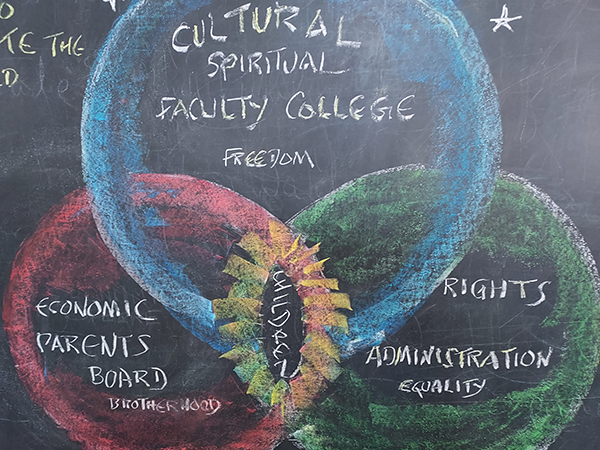
Visual representation of the Waldorf Three-Fold Approach.
