

"Our highest endeavor must be to develop free human beings who are able of themselves to impart purpose and direction to their lives."
-Rudolf Steiner
Waldorf FAQs
Frequently Asked Questions
Choosing the right school for your child is a deeply personal decision. Families exploring private K–8 education often have similar questions about academics, affordability, teaching philosophy, and community. Here, we’ve answered some of the most common questions parents ask about Waldorf when researching private schools.
-
Waldorf education is built on the understanding that children grow and learn in different ways at different stages of development. Rather than expecting every child to learn the same thing at the same time, the curriculum is thoughtfully designed to meet children where they are developmentally based on their age socially, emotionally, and academically. (There are limits to what teachers can accommodate in a classroom, read more here)
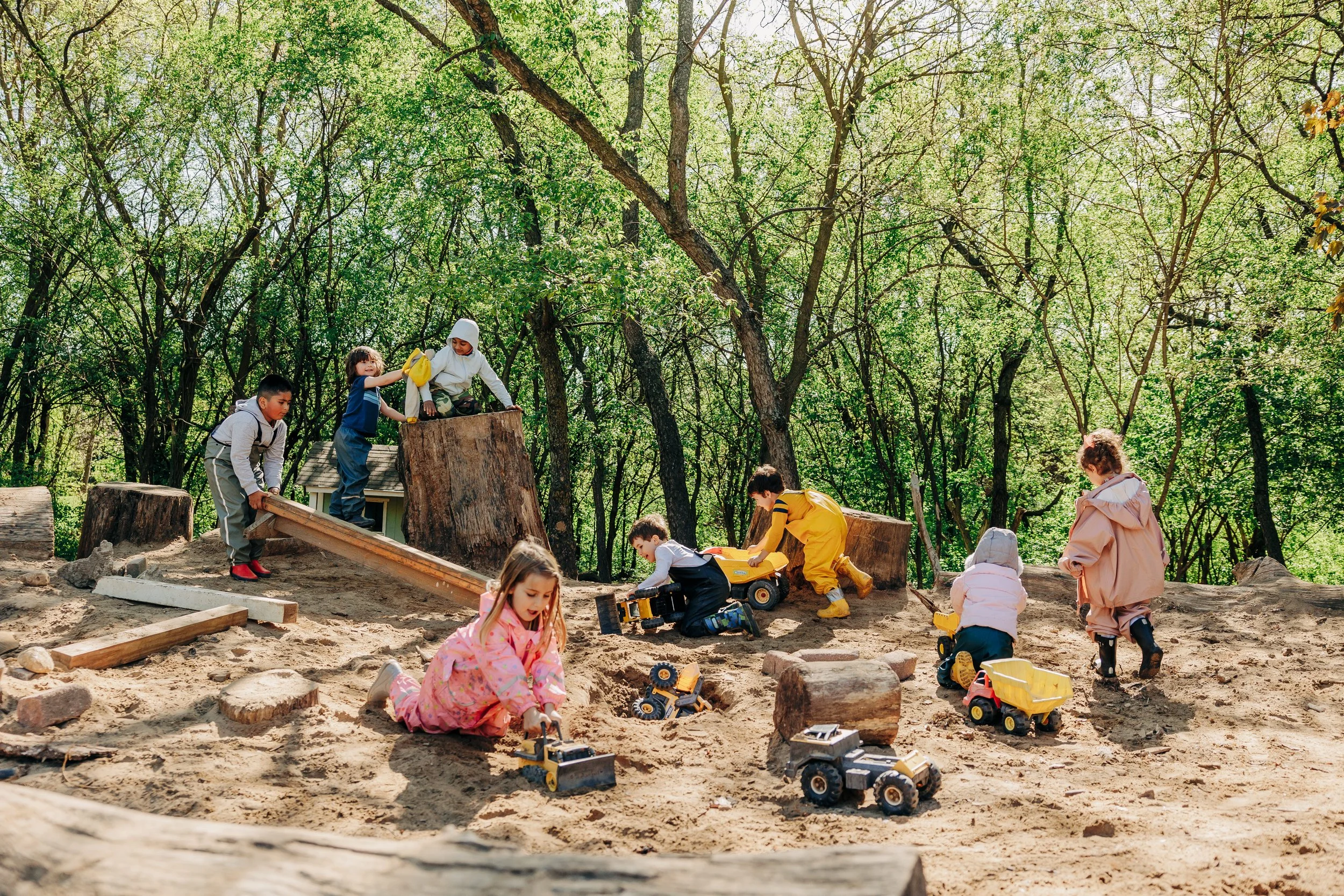
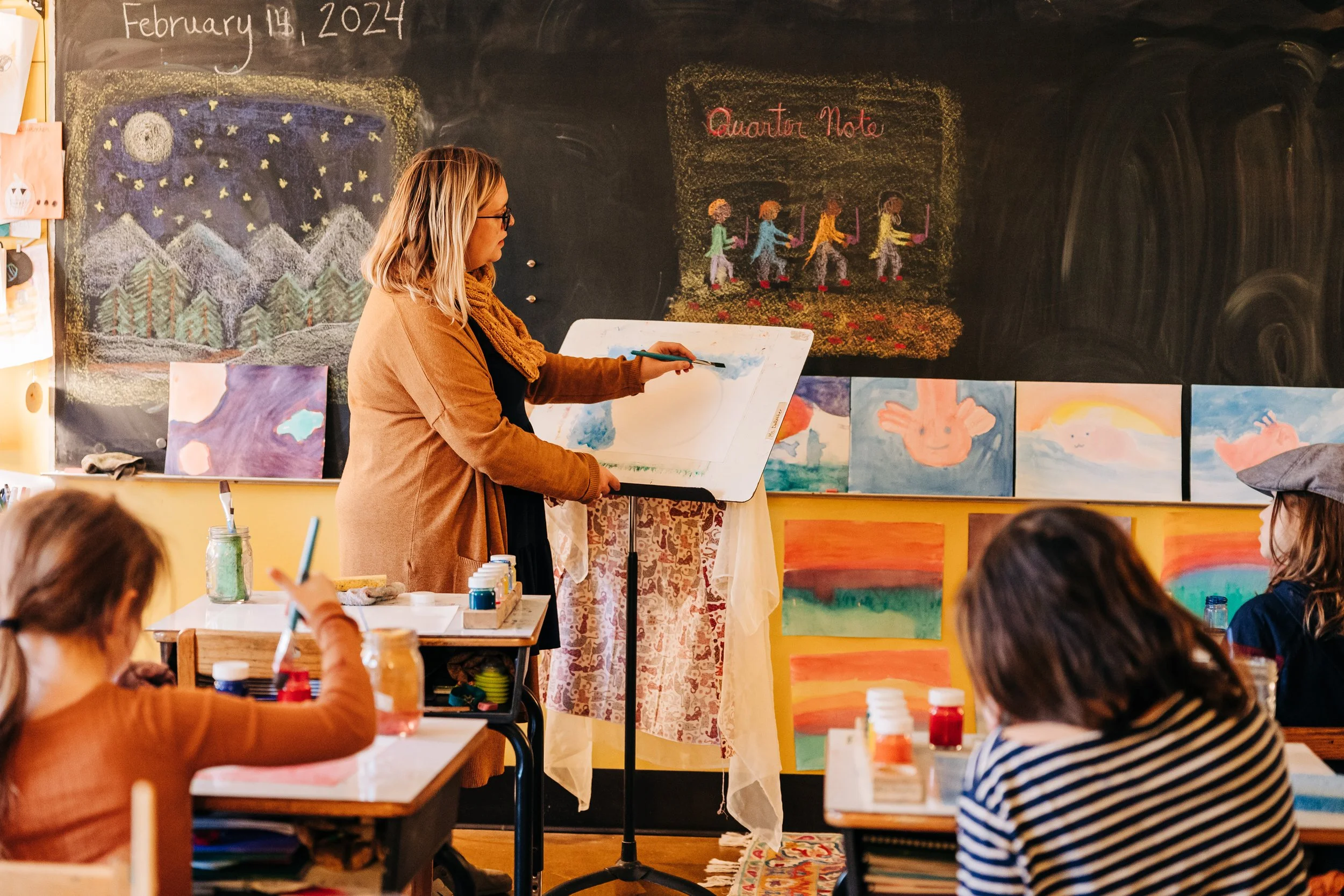
Learning in a Waldorf classroom is active, creative, and meaningful. Instead of simply memorizing facts, students explore ideas through storytelling, hands-on projects, science experiments, art, music, movement, and discussion. They ask questions, make observations, and discover concepts for themselves, helping them develop curiosity, critical thinking, and a genuine love of learning.
One distinctive feature of Waldorf education is that students create many of their own lesson books, filled with their writing, drawings, diagrams, maps, and reflections. These books become personal records of their learning and encourage them to process new ideas in a way that deepens understanding and strengthens memory.
Because the curriculum is carefully matched to each developmental stage of childhood, lessons are presented when they are most meaningful and engaging for that age.
A first grader learns differently from a fourth grader, and Waldorf teachers thoughtfully adapt both the content and the way it is taught to reflect those developmental differences.
The goal is not simply to help children succeed in school today, but to nurture confident, capable, and compassionate young people who are prepared to think independently, solve problems creatively, and meet the opportunities and challenges of the future with resilience.
-
For many families, the best measure of an education is not only how well children perform in school, but also the kind of people they become. Waldorf education is designed to develop strong academic skills alongside creativity, curiosity, resilience, and the confidence to think independently.
Our graduates consistently demonstrate that they are well prepared for the next stage of their education. Many begin high school enrolled in Advanced Placement (AP) or other honors-level courses and transition successfully to the increased academic demands of homework, testing, and independent study.
Because Waldorf students learn by asking questions, making observations, and discovering concepts for themselves, they often develop a deep understanding of what they study rather than simply memorizing information for a test. This approach helps build lasting knowledge, strong problem-solving skills, and the ability to apply learning in new situations.
Teachers at local high schools frequently tell us they value Waldorf graduates for their thoughtful participation, high-quality work, creativity, and ability to think critically. Students are known for asking insightful questions, working collaboratively, and approaching challenges with confidence.
The results continue beyond high school. Nationwide, approximately 94% of Waldorf graduates go on to attend college, and many pursue successful careers in a wide range of fields. More importantly, they leave school with a lifelong love of learning and the confidence to adapt in a changing world.
While every child's path is unique, Waldorf education aims to prepare students not just for the next test or the next grade, but for a lifetime of learning, purpose, and meaningful contribution.
Want a real-life example? Check out this post about of our alumni.
-
Assessment in a Waldorf school is about much more than a test score. Our teachers are trained observers who pay close attention to each child's learning every day not just the finished assignment or test result, but the process they use to get there.
As students work, teachers observe how they approach new challenges, solve problems, collaborate with classmates, persevere through difficult tasks, and express their understanding. This ongoing observation helps teachers recognize each child's strengths, identify areas where additional support is needed, and tailor instruction to help every student grow.
The curriculum is taught in focused "main lesson blocks," where students explore a single subject in depth over several weeks. At the end of each block, teachers review students' understanding through class discussions, projects, presentations, written work, artistic expression, and their beautifully crafted main lesson book pages. These main lesson books are regularly sent home so families can see the learning taking place in the classroom.
Parents also receive regular opportunities to discuss their child's progress. During parent-teacher conferences, held twice each year, the class teacher shares thoughtful feedback about each student's academic growth, social development, work habits, and overall well-being.
In addition, families receive detailed written reports mid-year and at the end of the school year.
Rather than assigning a single letter grade, these personalized reports are developed collaboratively by the lead teacher and subject teachers to provide a rich picture of each child's progress, celebrate accomplishments, and outline goals for continued growth.
By looking at the whole child over time, Waldorf assessment gives parents a deeper understanding of not only what their child is learning, but how they are growing as a learner and as a person.
-
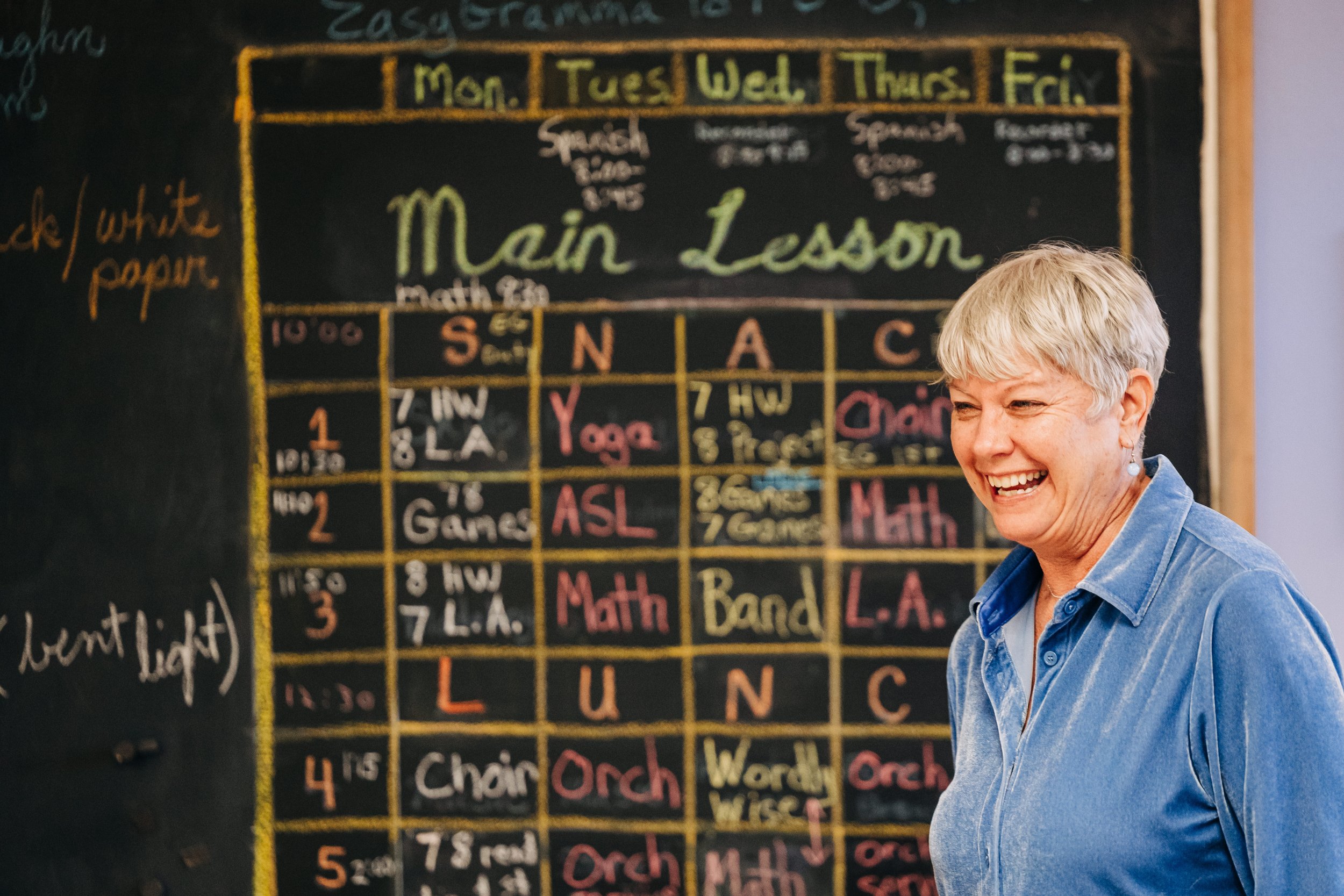
Imagine your child spending the morning completely immersed in a fascinating and developmentally relevant topic instead of rushing from one subject to the next. That's the idea behind the Waldorf Main Lesson Block.
For several weeks at a time, students focus on one core subject such as history, mathematics, language arts, botany, or geography allowing them to explore ideas in depth and develop a lasting understanding before moving on to the next topic.
Each Main Lesson begins with an engaging rhythm that helps children settle into learning. Depending on the age of the students, the morning may include movement, poetry, singing, mental math, storytelling, discussion, artistic activities, demonstrations, or hands-on experiences. New concepts are introduced in ways that invite curiosity and active participation, rather than simply asking students to memorize information.
As the weeks progress, students investigate the subject from many different perspectives. They conduct experiments, solve problems, create artwork, write summaries, make observations, and participate in lively classroom discussions.
Instead of working from a traditional textbook, they create their own beautifully illustrated lesson books, recording what they have discovered and learned in a way that is both personal and meaningful.
This extended focus allows children to ask deeper questions, make connections across subjects, and build confidence as their understanding grows. Teachers carefully guide the learning process, revisiting concepts in different ways and observing each student's progress throughout the block.
After the Main Lesson, students continue their day with a rich variety of classes including world languages, music, handwork, games class (physical education), and other subjects that round out the curriculum.
By giving children the time and space to explore a subject deeply, Main Lesson Blocks help transform learning from something to memorize into something they truly understand.
Check out this blog post to learn more!
-
In a world filled with screens and digital media, many families are asking an important question: How do we help children develop a healthy relationship with technology?
Waldorf education takes a thoughtful, developmental approach to technology. Rather than introducing screens and digital tools as the primary way children learn, Waldorf classrooms emphasize the experiences that help children build the skills technology cannot replace: creativity, critical thinking, communication, problem-solving, collaboration, and curiosity. To best foster these skills, we do not use screens in the classroom prior to 6th grade.
Research shows that young children learn best through direct experiences such as: through movement, conversation, hands-on exploration, imagination, and relationships with others. In the early grades, Waldorf students spend their time building these essential foundations through storytelling, art, music, nature exploration, practical work, and meaningful classroom experiences.
As students grow older, technology is introduced intentionally and purposefully starting in the 6th grade. Students learn how digital tools work, how to use information responsibly, and how to think critically about the role technology plays in their lives. Technology becomes a tool to support learning rather than a substitute for the human experiences that help children develop.
Waldorf education does not aim to keep students away from technology. Instead, it seeks to help them develop the judgment, creativity, and confidence to use technology wisely. A child who understands how to think, create, collaborate, and solve problems is better prepared to navigate an ever-changing digital world.
Families often choose Waldorf because they value:
More opportunities for hands-on, active learning
A childhood with space for imagination and creativity
Healthy boundaries around screens and media
Strong interpersonal skills and real-world experiences
A thoughtful introduction to technology when students are developmentally ready
The ambition is not to create the belief that technology and screens are inherently bad. Rather, our aim is to prepare them to enter a technological world as capable, thoughtful, and responsible human beings.
-
In Waldorf education, math and science are taught as subjects to be explored, experienced, and understood, not simply memorized. Students build strong academic foundations while developing curiosity, critical thinking, and confidence in their own ability to solve problems.
Math begins with hands-on experiences that help children develop a true understanding of number sense and mathematical relationships. Younger students learn through movement, rhythm, games, storytelling, and practical activities before gradually moving toward more abstract concepts. As they grow, they tackle arithmetic, fractions, geometry, algebra, and advanced mathematics with an emphasis on understanding why mathematical concepts work, not just how to arrive at the correct answer.
Science begins with careful observation of the natural world. Students spend time outdoors, conduct experiments, make detailed observations, and record what they discover through writing and illustrations. Rather than immediately giving students the answers, teachers guide them to ask questions, notice patterns, and draw conclusions based on what they observe. This process encourages curiosity, scientific thinking, and a genuine appreciation for the world around them.
As students progress through the grades, the science curriculum expands to include life science, earth science, chemistry, and physics. Experiments and demonstrations become increasingly sophisticated, and students learn to think analytically while connecting scientific concepts to real-world experiences.
Throughout both math and science, students create their own lesson books filled with notes, diagrams, experiments, calculations, and reflections. These books become a personal record of their learning and demonstrate not only what they know, but how their understanding has developed over time.
The goal is to help students become capable problem-solvers who approach challenges with curiosity, perseverance, and confidence. By learning through observation, investigation, and discovery, Waldorf students develop the skills they need for high school, higher education, and a rapidly changing world.
-
No. Waldorf schools are not religious schools, and families of many different faiths as well as families with no religious affiliation are welcome in our community.
Our goal is not to teach children what to believe, but to help them develop respect, curiosity, and appreciation for the many ways people seek meaning and connection in the world.
As students move through the grades, they learn about the stories, traditions, and cultural contributions of many of the world's religions, including Christianity, Judaism, Islam, Buddhism, Hinduism, and others. These are presented as part of a rich study of history, literature, and human culture not as religious instruction. Students are encouraged to ask questions, think thoughtfully, and develop an understanding of diverse beliefs and traditions.
You may also hear that Waldorf education was developed through the work of Austrian philosopher and educator Rudolf Steiner. His broader philosophy, called anthroposophy, offers ideas about child development, the importance of imagination, and educating the whole human being. It serves as a framework and source of inspiration for Waldorf teachers and informs the educational approach, but it is not taught as a subject, nor are students expected to accept or practice anthroposophy.
What children experience each day is a joyful, engaging education filled with stories, literature, mathematics, science, music, movement, languages, handwork, the arts, and meaningful relationships with their teachers and classmates. Families are never asked to adopt a particular worldview, and students are free to bring their own religious traditions, cultural backgrounds, and family values into the school community.
We believe one of the greatest gifts we can offer children is an education that helps them become thoughtful, compassionate, and open-minded citizens who can engage respectfully with people from many different backgrounds and beliefs.
-
Yes. Children transition from Waldorf schools to public and independent schools every year, and most adjust well to their new learning environment.
While every school has its own curriculum and teaching style, Waldorf students leave with a strong foundation in literacy, mathematics, critical thinking, and problem-solving. Just as importantly, they have developed habits that help them succeed in any classroom: Curiosity, perseverance, organization, and the confidence to ask questions and tackle new challenges.
The most noticeable differences are often in how students have learned rather than what they have learned. Waldorf students are accustomed to hands-on learning, meaningful discussions, artistic expression, and exploring subjects in depth. As they transition to a more traditional classroom, they adapt to new routines such as textbooks, letter grades, standardized testing, and increased use of technology.
Our teachers work closely with families during any transition, helping parents understand what to expect and providing records and recommendations to support a smooth move. Because every child is unique, we also consider the timing of a transition and the individual needs of each student.
Many of our graduates go on to thrive in public, private, and college-preparatory high schools. Teachers often comment on their strong work habits, creativity, thoughtful participation, and ability to think independently.
Whether a child remains in Waldorf through 8th grade graduation or transitions to another school along the way, our goal is the same: to help every student become a confident learner who is prepared to succeed wherever life takes them.
-
Waldorf and Montessori are two of the most widely recognized child-centered educational approaches in the world, along with Reggio Emilia. All three share a deep respect for children and a belief that learning should honor each child's individual development, curiosity, and natural desire to explore.
While Waldorf and Montessori share many values, they take different approaches to how children learn.
Montessori education emphasizes independence, self-directed learning, and hands-on exploration. Children often choose from carefully designed learning materials and work at their own pace, developing concentration, practical skills, and confidence through individual discovery.
Waldorf education also values independence and hands-on learning, but places a greater emphasis on imagination, creativity, relationships, and learning through experience. Teachers thoughtfully guide students through a curriculum that is designed around the developmental stages of childhood, bringing subjects to life through storytelling, movement, art, music, nature, and hands-on experiences.
Both approaches recognize that children learn best when they are engaged, respected, and actively involved in their education. The difference is in the pathway: Montessori often begins with carefully designed materials that allow children to discover concepts independently, while Waldorf often begins with rich experiences that awaken curiosity, imagination, and a deeper connection to the subject.
The best choice for a family depends on the child and the educational environment where they feel most inspired to learn. Families who are drawn to creativity, storytelling, strong teacher relationships, the arts, and a thoughtfully paced approach to academics often find Waldorf education to be a wonderful fit.
-
Public schools provide an important and valuable educational experience for millions of children, and many families have wonderful experiences in their local public schools. Choosing the right school is ultimately about finding the environment where a child will be known, supported, challenged, and inspired to learn.
Waldorf education shares many important goals with public education: helping children develop strong academic skills, become thoughtful citizens, and prepare for the future. Where Waldorf differs is in the way learning is approached and the emphasis placed on the whole child.
In a Waldorf classroom, teachers intentionally consider each child's developmental stage, learning style, and individual strengths. Because classes are smaller, teachers are able to build deep relationships with students and closely observe their academic growth, social development, creativity, and confidence over time.
A Waldorf education places strong emphasis on learning through experience. Students engage with ideas through storytelling, discussion, hands-on projects, artistic expression, movement, nature, and collaboration. Rather than focusing primarily on memorizing information, students are encouraged to ask questions, think critically, make connections, and develop the ability to approach new challenges with confidence.
Technology, testing, and academic content are introduced thoughtfully and intentionally in Waldorf schools, with the goal of helping students develop the judgment and skills they need to use these tools effectively.
One of the greatest differences families often notice is the balance between academic learning and the development of creativity, curiosity, resilience, and independence. Students are encouraged not only to know the right answer, but to understand the process of discovery that leads them there.
For families considering their options, the question is not whether Waldorf or public school is "better." The question is: Which environment best supports your child's unique way of learning and growing?
Families often choose Waldorf because they value:
Strong relationships between teachers and students
Small class communities where children are truly known by their peers and adults in their life
A curriculum that integrates academics with the arts and hands-on learning
A thoughtful approach to applying what we know about childhood development
The cultivation of creativity, confidence, and independent thinking
At its heart, Waldorf education is about preparing children not only to succeed in school, but to become capable, curious, and compassionate human beings who are ready to meet the world ahead.
-
Many families are drawn to homeschooling for the same reasons families choose Waldorf education: a desire for a more personal approach to learning, a focus on the whole child, and an environment where curiosity and creativity can thrive.
Both homeschooling and Waldorf education offer opportunities for children to learn beyond a traditional classroom model. Both can provide meaningful experiences through hands-on projects, nature exploration, the arts, practical skills, and learning that connects to the real world.
One difference is that Waldorf families benefit from being part of a larger learning community guided by experienced teachers who are specially trained in child development and the Waldorf approach. Teachers create a carefully balanced curriculum, observe each child's progress, and bring years of experience in guiding academic, social, and creative growth.
Waldorf education also provides the rhythm and community that many homeschooling families value. Students learn alongside a consistent group of peers, build friendships, collaborate on projects, participate in group activities, and develop independence within a supportive classroom environment.
Like many homeschooling families, Waldorf schools place importance on protecting childhood, encouraging imagination, spending time outdoors, and allowing children to develop at a healthy pace. Students are not simply moving from assignment to assignment. They are engaging deeply with ideas, creating, exploring, and discovering.
For some families, homeschooling is the ideal fit. For others, Waldorf provides a similar philosophy of education with the added benefits of a dedicated teaching team, a rich curriculum, and a vibrant community.
Families often choose Waldorf because they want:
A slower, more intentional approach to childhood
Less emphasis on screens and passive learning
Hands-on, creative, experiential education
Strong teacher relationships
A close-knit community of families
The benefits of a carefully designed curriculum without having to create it all themselves
At its heart, Waldorf education shares a common belief with many homeschooling families: children thrive when learning is meaningful, relationships are strong, and their natural curiosity is nurtured.


Questions
We’re so glad you’re exploring The Waldorf School of DuPage! Choosing the right school is an important decision, and we know you may have questions along the way. This FAQ page is here to provide quick, helpful answers about our programs, philosophy, admissions process, tuition model, and more.
If you don’t see your question here, we’re always happy to help—please feel free to reach out to us directly. We’re here to support you every step of the way.
You can also explore our Blog. This thread has various posts dedicated to helping you understand Waldorf.

